October 2026 Market Update: Playing the Long Game
- Investments

October is one of my favorite times of the year. The weather starts to change, football is in full swing, and after 162 games, the MLB playoffs begin. Six months of baseball have whittled 30 teams down to 12, and eventually one of them will be crowned World Series champion.
There is something about a 162-game season that feels appropriate as we close out the third quarter in the markets.
No great baseball team goes 162-0. Even the best teams go through stretches when the bats go cold, the bullpen struggles, or a team they should beat gets the better of them. Over a season that long, success is not determined by one game, one series or even one difficult month. The best organizations build a roster for the entire season, adjust along the way and put themselves in position to be playing their best baseball when it matters most.
Investing is not all that different. Through the first nine months of 2026, our portfolios are trailing their respective benchmarks. We pay attention to that, and we certainly don't like trailing any more than our clients do. But we must keep nine months in perspective. Historically, our portfolios have outperformed their respective benchmarks over longer measurement periods. That success did not come from trying to win every month or chasing whichever part of the market happened to be leading at the time. It came from a process built to compound wealth over full market cycles.
Playing a Different Lineup
The S&P 500 gained roughly 2% during Q3, but that number does not tell the whole story. The equal-weighted S&P 500 fell about 2%, and the Russell 2000 declined roughly 7%. Even more striking, just four of the largest technology companies contributed more than 200% of the S&P 500's entire quarterly gain. The rest of the index collectively lost ground.
That type of market can be difficult for a diversified portfolio to keep pace with. When a handful of the largest companies are responsible for essentially all the gains, owning anything different from the index can temporarily become a headwind.
We entered Q3 after an exceptional run from technology, artificial intelligence and many of those same large companies. We still believed in them, but prices had become stretched. We took some profits and moved capital toward smaller companies and value, where we believed investors were being better compensated for the risk they were taking. That decision has not been rewarded yet.
Small caps and value struggled late in the quarter while the largest companies continued to lead. That contributed to our portfolios trailing their benchmarks this year. We are comfortable acknowledging that because our process has never been built around trying to look exactly like an index. But being patient does not mean sitting still.
Making Adjustments
September gave us new information. Interest rates continued moving higher and smaller companies came under increasing pressure. Smaller businesses generally rely more heavily on outside financing and have less flexibility to absorb higher borrowing costs. Compare that with one of the largest technology companies, which held more than $240 billion in cash and marketable securities on its balance sheet at the end of June. Higher rates still matter to a company like that, but a business sitting on that much liquidity is far less dependent on borrowing to fund its operations and future growth. A smaller company that needs access to loans and outside capital feels a rate increase much more directly. That difference became increasingly important as the quarter progressed and played a role in our decision to reduce the size of our small-cap overweight.
We had spent several months building our small-cap and value exposure because we believed the valuation opportunity justified it. As the environment changed, the size of that opportunity changed too.
We still see long-term value in smaller companies, but we no longer believe the same size overweight is warranted today. We began adjusting in September, and as the fourth quarter begins, we are taking a much larger step.
Changing the Lineup
We are significantly reducing our exposure to small-cap value and trimming our allocation to quality-focused large companies. Those dollars are being reallocated primarily toward the broader U.S. market, large U.S. companies and technology. We are also adding a small position in broad small-cap stocks, so we are not abandoning small caps. We are reducing the concentration of the overweight while maintaining exposure.
This is a meaningful allocation shift, but it is not a change in philosophy. We are still taking risk. We are changing where we want to take it.
Technology is a good example. Earlier this year, we reduced exposure after a tremendous run pushed valuations higher. Since then, valuations have reset while earnings have remained strong. We never lost conviction in artificial intelligence or the enormous investment taking place around it. We simply became more demanding about what we were willing to pay.
Today, the price and opportunity look different, and we are willing to put some of that capital back to work.
What This Means for Each Portfolio
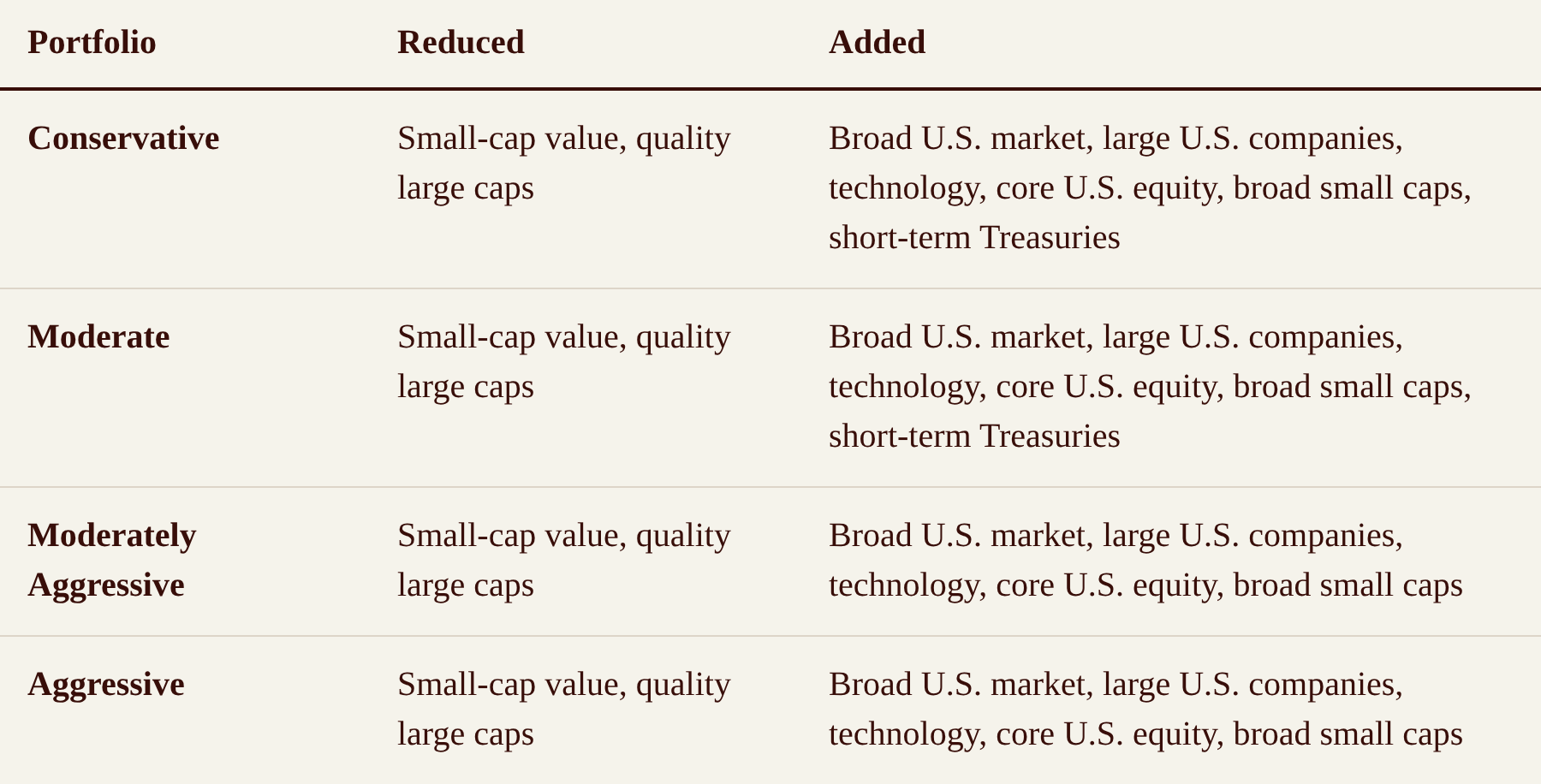
Conservative. The Conservative Portfolio remains focused on protecting capital and generating income while participating in long-term market growth. We reduced its small-cap and value concentration and broadened the equity allocation, while adding to short-term Treasuries to maintain its conservative structure.
Moderate. The Moderate Portfolio continues to balance long-term growth with protection. We reduced the small-cap and value overweight, spread that capital across a broader portion of the U.S. market and increased short-term Treasuries. The portfolio remains balanced while giving us broader participation entering the fourth quarter.
Moderately Aggressive. The Moderately Aggressive Portfolio remains firmly positioned for long-term growth. This month's changes broaden where we are taking risk by reducing our small-cap and value exposure and increasing exposure to the core U.S. market, large companies and technology.
Aggressive. The Aggressive Portfolio remains 100% equity and focused on long-term capital appreciation. We are reducing the size of our small-cap and value overweight and putting more capital behind the broader U.S. market and technology. We remain fully invested and aggressive, but have broadened where we are taking that risk heading into the fourth quarter.
Built for a Full Season
Nine months into 2026, our portfolios have delivered strong returns through what has been an incredibly volatile year. We are slightly behind our benchmarks, but perspective matters. A handful of the largest companies have driven an outsized portion of the market's gains, while many other areas of the market have experienced a much bumpier ride. Through it all, our portfolios have continued to grow while we have actively adjusted where and how we are taking risk.
Our process identifies value and prescribes where money should flow. Sometimes that means taking profits from an area after a tremendous run. Sometimes it means investing in an area that has been overlooked. And sometimes it means recognizing that the opportunity has shifted and adjusting the lineup again. We did all three during the third quarter.
October baseball is a good reminder that a season is long for a reason. No team is defined by one game, one series or one difficult stretch. After 162 games, the teams still playing are there because of the body of work they put together throughout the season and the adjustments they made along the way.
We think about portfolios the same way.
We have now made it through September, historically one of the most difficult months on the market calendar, and we like where we sit entering the home stretch of 2026. Earnings remain strong, valuations have improved in several areas we want to own, and the changes we have made leave the portfolios broader and better positioned for the opportunities we see ahead.
There will always be another curveball. That is part of investing. Our responsibility is to keep studying the game, adjust when adjustments are warranted, and keep portfolios positioned to compete through the entire season.
The calendar has turned to October. The portfolios are positioned, the opportunities are there, and there is plenty of baseball left to play.
Important Disclosures
Market index data as of October 2, 2026. Portfolio changes described reflect model adjustments implemented in October 2026.
References to index performance are based on data believed to be reliable as of 10/01/2026, sourced from third-party market data providers. Past market patterns are not predictive of future results and are provided for informational and educational purposes only.
Portfolio activity described herein (Conservative, Moderate, Moderately Aggressive and Aggressive) reflects changes made at the model level. Individual client account holdings and performance may differ materially from the model portfolios described due to factors including, but not limited to, timing of implementation, cash flows, tax considerations, legacy or restricted positions, client-imposed restrictions, and assets held away from Croak Capital's management. Model portfolio allocations are as of 10/01/2026 and are subject to change without notice.
This commentary reflects the opinions of Croak Capital as of 10/01/2026 and is subject to change without notice. It is provided for informational purposes only and does not constitute investment, tax or legal advice, nor an offer or solicitation to buy or sell any security. Forward-looking statements regarding market conditions or portfolio positioning are not guarantees of future results. Past performance is not indicative of future results. All investments involve risk, including the possible loss of principal.